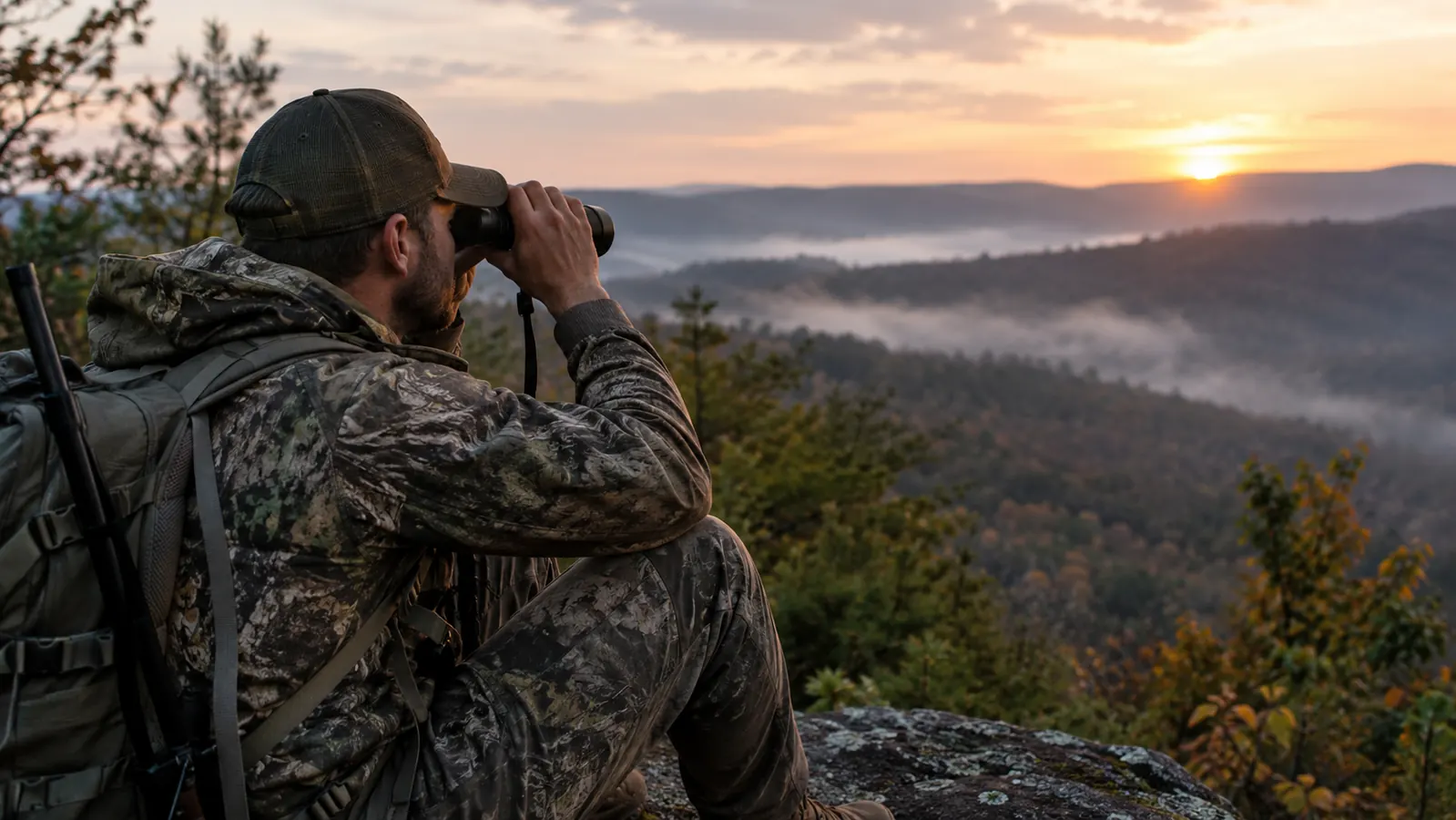
If you hunt turkeys from a ridge, you know the feeling. You get set before light, hear the first gobble, and then spend the next hour staring at a hillside full of shadow and downed timber, trying to tell a bearded bird from a stump. I did that for years with an old compact pair that was fine for watching a deer at a feeder and useless for reading turkey country. Last spring I switched to the Vortex Crossfire HD 10x42, and it changed the way I set up more than any call I own.
I am Cal Brewer, 54. I hunt deer and turkeys on family land and a public wildlife area in Kentucky, usually from a ground blind or a ladder stand, and my dog Scout rides along most trips. The routine I use now came from trial and error, a few blown setups, and one morning when a gobbler crossed an open bench while I was staring at the wrong draw. This is the exact sequence I run with the Vortex Crossfire HD 10x42, plus the mistakes I still make when I get in a hurry.
Start with the 10x42 that actually resolves a ridge at first light
I have used this pair all spring, and it has been the difference between seeing birds and guessing at shadows. If you are shopping for a pair like this, see today's price on Amazon.
Amazon Check Today's Price on Amazon →Step 1: Set up on the high side of the ridge before the birds talk
Pick your spot the afternoon before, not in the dark. I like to be on the high side of the ridge, far enough back from the lip that my silhouette does not cut the skyline. On a piece of public ground I hunt, that usually means a flat bench about forty yards below the top, with a big oak between me and the opening. I set the ladder stand the weekend before season, trim one shooting lane, and mark the spot on my phone. I found this spot two seasons ago when a bird gobbled from the same bench three mornings in a row. The bench runs about a hundred yards along the contour, and the oak I use is the third one past a fallen beech. Knowing exactly where to sit saves me ten minutes of fumbling in the dark. The goal is simple: I want to look down into the next hollow, not across into a wall of brush.
From that seat, the Vortex Crossfire HD 10x42 gives me a wide enough view to cover the whole face of the ridge. I scan left to right in strips, starting at the bottom of the hollow and working up. I go slow, about thirty seconds per strip. On a clear morning I can cover the bench and the draw below it without moving the binoculars more than a few inches. When the light is flat, I slow down to forty-five seconds per strip and use the edge of the field as a reference line. If I rush, I miss the bird that is standing still in the shadows, which is most of them.
The mistake I made for years was getting set up on the same level as the birds. Turkeys see movement on a flat plane much faster than they see it from above. Being high also lets the binoculars work with the light instead of against it. By the time the sun is up, I am already looking down the ridge with the glow behind me. Last year I tested the same setup from the bottom of the hollow and from the bench. The bench produced three close encounters; the bottom produced one bird that saw me first.
Step 2: Glass in strips and pause on anything that looks like a bird
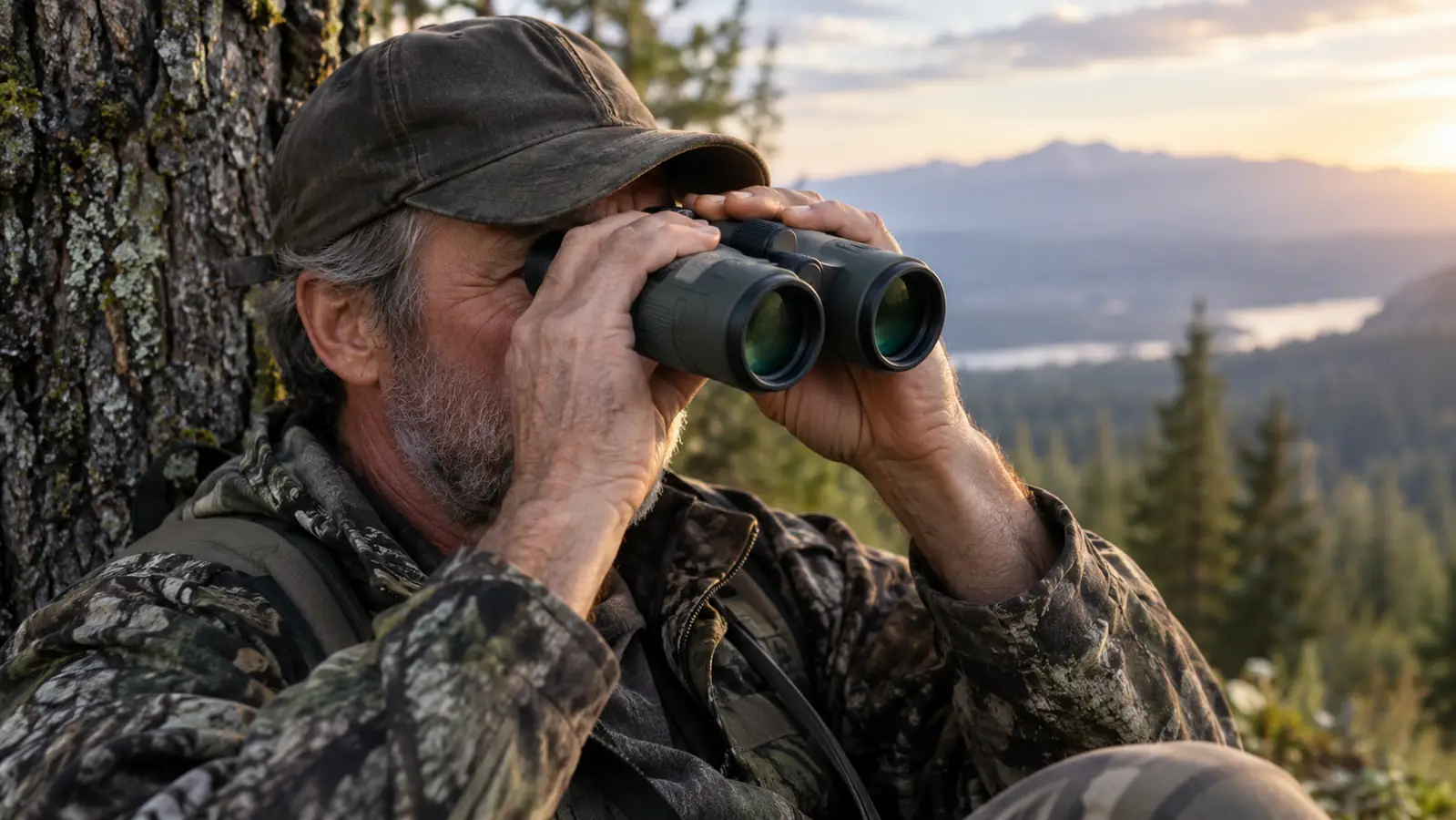
I divide the ridge into three or four sections and work them one at a time. With 10x magnification, I can pick out a turkey at two hundred yards if it moves, but the trick is finding them before they move. That means stopping on every dark blob, every stump with a rounded top, every shadow that does not look quite right. I hold on it for ten full seconds. If it does not move, I drop down one strip and keep going.
This is where a clear image matters. The Vortex Crossfire HD has fully multi-coated lenses and HD glass, and on an overcast morning I can see feather detail on a bird at a hundred yards. On my old pair, that same bird was just a dark shape. The difference is not about being able to read a brand name on the objective lens. It is about whether your eye can separate a turkey's head from a leaf. That separation is what lets you pass on a hen and wait for the gobbler to show himself.
I also use the focus knob more than people expect. I start each strip slightly out of focus, then dial it in. The motion catches my eye, and it forces me to look at the whole scene instead of locking onto one spot. It sounds backwards, but it works. I found that trick by accident one morning, and it has saved me more than once.
Step 3: Use the gobble to triangulate, then put the binoculars down
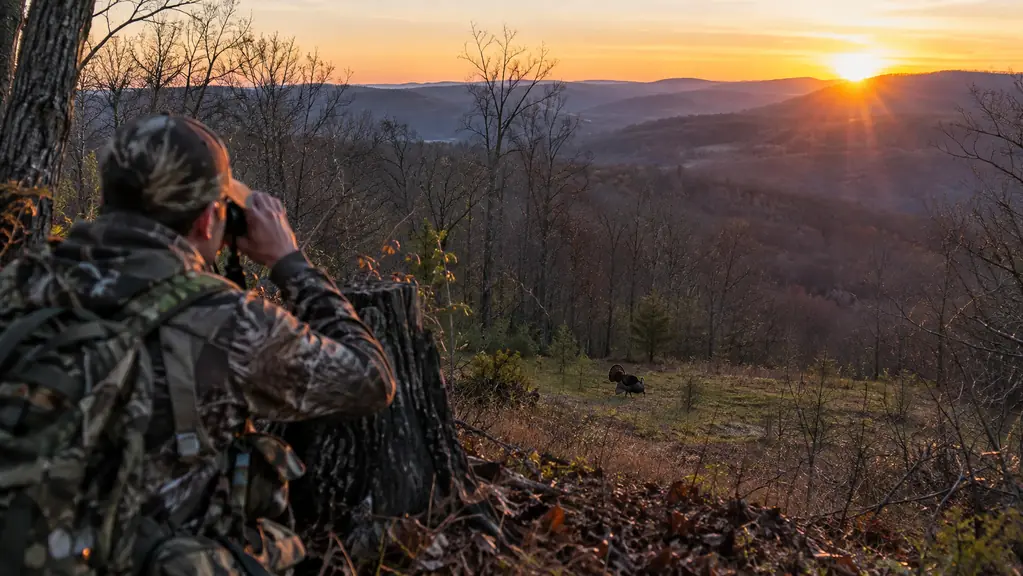
When a bird gobbles, the natural reaction is to raise the binoculars and stare at the sound. I do that too, but only for a few seconds to mark the general area. Then I put the binoculars down, pick a landmark like a lone dead snag or a rock pile, and watch that spot with my bare eyes. Turkeys often gobble from the roost, fly down, and then show up a hundred yards away from where they sounded off. The binoculars are for finding them after they move, not for pinning them to the tree. I also note the time. Turkeys are predictable in the first thirty minutes after fly down, and knowing whether I am hearing an early gobble or a late one tells me whether to expect him on the ground or still in the tree.
One morning last April, a bird gobbled twice from what sounded like the middle of the hollow. I kept the binoculars on the roost tree and missed him walking down a logging road to my left. He came out at the bottom of the draw, crossed a dry creek, and disappeared behind a ridge before I ever got my eyes on him. The next morning I tried the landmark method and had him at forty yards by seven o'clock. That one hunt changed my whole setup. The logging road is still my reference point for that whole drainage. Every time I set up there now, I face the road first and let the gobbles confirm what the map already told me.
Keep a mental map of where each gobble comes from, and mark the direction with your body. I square my shoulders toward the sound, then use the binoculars only to check the spots where a turkey could appear. It is a hard habit to learn because the binoculars feel like the tool you are supposed to use. But the birds that fill tags are usually the ones you see out of the corner of your eye while you are looking somewhere else. I keep a small notebook in my vest and jot down the direction of each gobble and the landmark I chose. That sounds like extra work, but it takes fifteen seconds and it makes the next hunt easier.
Step 4: Let the ridge tell you where to set the decoy
Once I know where the birds are, I do not charge straight at them. I use the binoculars to find the route they are likely to take, then I set up ahead of that route. On the public area I hunt, that means looking for a saddle where two ridges come together, a bench with a few scattered oaks, or a strip of open ground between two thickets. Turkeys like to travel along the path of least resistance, and they will almost always stop in a place where they can see.
The 10x42 lets me check those spots from a distance without bumping birds. I look for droppings, scratched-up leaves, and the occasional feather. If I see fresh sign in a bench, I set the decoy on the downwind edge and tuck myself against a tree thirty yards off. I have learned that the decoy does not need to be in the middle of the opening. It needs to be where a turkey would naturally feed through, or the real birds will walk around it.
This is where the Vortex earns its keep for me. The extra light gathering of the 42mm objective helps in the low light of early morning, and the 10x magnification lets me read sign at a distance without walking through the area. I can glass a bench for five minutes, find the exact spot where the birds have been scratching, and set up without ever putting a boot in the middle of their feeding area.
Step 5: Keep the binoculars handy during the setup, then switch to the call
Most people hang the binoculars on a strap and leave them in the truck when they get close. I keep mine around my neck until I am sitting against the tree. The last hundred yards of a setup is when birds are most likely to move, and a quick glassing check can save a blown approach. I stop every twenty yards or so, kneel behind a tree, and scan the area where I expect the bird to be. If I see him before he sees me, I can adjust my route. One time that check kept me from walking into a hen that was feeding along the edge of the field. I saw her, backed out, and came in from the other side. The gobbler came with her twenty minutes later.
Once I am set, the binoculars go on the ground beside me, within easy reach. I use them again after the shot, or if a bird hangs up. A hung-up turkey is one of the hardest things to read, and being able to glass the edge of the field without moving my head is a big advantage. I have called birds in close enough to see their beards without binoculars, but I have also watched a longbeard hang up at eighty yards and slip away while I was fumbling with my call. Now I set the call down as soon as a bird answers, and I keep one hand on the binoculars until I know exactly where he is. If he hangs up, I can watch him turn and leave, and I learn something for the next setup.
The Vortex Crossfire HD has been durable enough for all of it. It has bounced around in my pickup, sat in the bottom of my jon boat, and ridden in a vest pocket on warm April mornings. The rubber armor takes the bumps, the focus wheel stays smooth, and the diopter has not slipped. I still keep the lens caps on when it is not in use, and I wipe the glass with a microfiber cloth at the end of each hunt. I also make a habit of checking the focus before first light. The temperature change can make the wheel feel stiff, and a quick twist while it is still dark saves me from missing the first bird of the day. That is about all the maintenance it needs.
What Else Helps
Besides the binoculars, three things make glassing a turkey ridge easier. First, a lightweight tripod or a shooting stick gives your arms a rest on long sits. I use a cheap monopod that doubles as a walking stick, and it steadies the image enough to pick out a bird at three hundred yards. Second, a small seat cushion keeps you comfortable enough to stay still. Fidgeting is what turkeys notice, not the color of your clothes. Third, a good pair of gloves with the fingertips cut out keeps your hands warm without making the focus wheel clumsy. None of that is expensive, and all of it makes the binoculars easier to use.
One thing I skip is a phone adapter for taking pictures. It is fun to have, but it adds weight and makes me mess with the binoculars when I should be watching. If I want to remember a hunt, I take a mental picture and write it down at the truck. That keeps my hands free and my eyes on the ridge.
The next morning I tried the landmark method and had him at forty yards by seven o'clock. That one hunt changed my whole setup.
Bring the Vortex Crossfire HD with you next time you climb a ridge
I have used this pair on every hunt this spring, and it has earned a permanent spot in my vest. Check today's price on Amazon before your next setup.
Amazon Check Today's Price on Amazon →